What Bà Ngoại Knows That No Teacher Ever Will
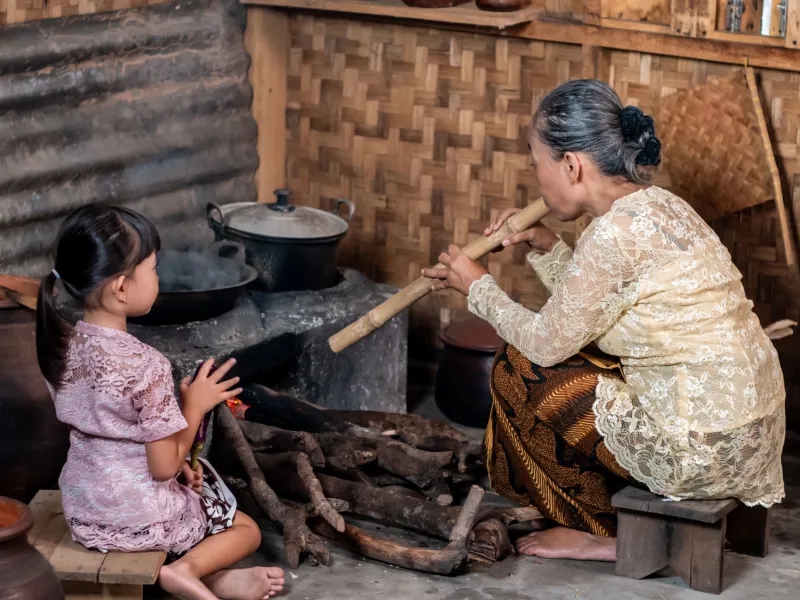
There's a moment that 19-year-old Mia Trần from San Jose still talks about. She was nine years old, struggling with a math worksheet at the kitchen table, when her grandmother — Bà Ngoại, who'd survived the fall of Saigon and raised five kids in a one-bedroom apartment in Garden Grove — sat down beside her. Bà didn't look at the worksheet. She told Mia a story instead. About calculating rice rations. About knowing, to the grain, how much food a family needed to survive another week.
"She wasn't trying to teach me math," Mia says. "She was teaching me what math was for."
That distinction — between knowledge and the purpose of knowledge — is exactly what's making Vietnamese-American grandparents some of the most quietly powerful educators in the country right now. No credentials. No classroom. No lesson plan. Just decades of lived experience meeting the specific hunger of a generation trying to figure out who they are.
The School Nobody Enrolled In
Across Vietnamese-American communities — from Little Saigon in Westminster to the growing enclaves in Houston, New Orleans, and the Twin Cities — grandparents are filling a gap that formal education simply wasn't designed to close. They're teaching resilience, cultural pride, practical wisdom, and a sense of self that can hold up under the pressure of being hyphenated in America.
Dr. Linda Nguyễn, a researcher at UC Irvine who studies intergenerational cultural transmission, calls it "informal inheritance." "We talk a lot about what schools teach Vietnamese-American kids," she says. "We almost never talk about what grandparents teach them. And in many cases, the grandparent curriculum is the one that actually sticks."
It sticks because it's personal. Because it arrives through smell and sound and story, not through standardized testing. Because it comes from someone who loves you and has also, genuinely, survived things.
Lessons That Don't Look Like Lessons
Ask any Vietnamese-American in their late teens or twenties what they learned from their grandparents and the answers tend to arrive sideways — not as lessons but as moments.
Kevin Phạm, 22, from Houston, learned discipline from his Ông Nội through early-morning tai chi sessions in the backyard. "He never called it exercise. He called it giữ thân — keeping the body." Kevin is now pre-med, and he credits those 5 a.m. sessions less with keeping him physically fit and more with teaching him how to show up consistently when nobody's watching.
For Jasmine Lê, 17, from Falls Church, Virginia, the curriculum arrived through cooking. Her Bà Nội refused to write down recipes. "She said if you have to write it down, you don't know it yet." Jasmine spent three years learning to make canh chua — sour soup — entirely by feel, by smell, by the way the tamarind looked when it hit the broth just right. She's applying to culinary school this fall. She says she already has her thesis.
In Philadelphia, 21-year-old Thomas Vũ learned negotiation from watching his grandfather run a small import shop in South Philly. "Ông never taught me business. But every Saturday, I watched him talk to suppliers, to customers, to the landlord. I learned how to read a room. How to be firm without being rude. That's not something you learn in a business class."
The Language of Survival
What runs through all of these stories is something harder to name than a skill. It's closer to a worldview — a particular way of seeing difficulty not as an obstacle but as information.
Many Vietnamese-American grandparents came to this country carrying experiences that most Americans will never have to imagine: displacement, loss, the complete dismantling of a life and the slow, stubborn work of rebuilding one. That experience doesn't disappear. It gets transmitted, often without anyone realizing it's happening.
"My grandmother never talked directly about the war," says Mia Trần. "But she talked around it constantly — in the way she saved everything, in the way she never wasted food, in the way she always knew three ways out of any situation. I grew up understanding that the world could change fast and you had to be ready."
Dr. Nguyễn calls this "embedded resilience." "It's not taught as a concept. It's modeled as behavior. And children absorb it at a cellular level."
When the Grandchild Becomes the Bridge
The relationship isn't one-directional. Increasingly, Vietnamese-American grandparents and grandchildren are learning from each other in ways that are quietly reshaping both.
Grandparents are learning how to video call, how to navigate American healthcare systems, how to understand a grandchild's experience of being Vietnamese in a school where nobody looks like them. Grandchildren are learning the language — not just Vietnamese words but the emotional vocabulary of a culture that expresses love through action, not declaration.
"My Bà Ngoại doesn't say 'I love you,'" says Jasmine Lê. "She says 'Did you eat?' It took me until I was about fifteen to understand those are the same sentence."
That translation — learning to hear what's being said beneath what's being said — might be the most sophisticated education a young person can receive. And it's happening in kitchens and backyards and Saturday morning tai chi sessions all across America, completely off the record.
The Recognition Gap
Here's what's frustrating, though: almost none of this gets counted. No school district tracks it. No college application has a box for it. No one is studying the long-term outcomes of kids who grew up spending Saturday afternoons with a grandmother who remembered everything.
That invisibility is itself a kind of cultural problem. When we talk about closing achievement gaps or building resilient communities, we tend to look at institutions — schools, nonprofits, government programs. We almost never look at the 72-year-old woman in a Garden Grove apartment who has been running the most effective character education program in the neighborhood for the last fifteen years.
"I want people to understand that what grandparents do is real education," says Dr. Nguyễn. "It's rigorous. It's intentional, even when it doesn't look intentional. And it produces outcomes that institutions are actively trying to replicate and failing."
The Urgency of Now
There's a clock ticking underneath all of this. Vietnamese-American grandparents — the ones who came over in the late 1970s and 1980s, who built the first waves of community in America — are aging. The window for this kind of transmission is real, and it's finite.
Mia Trần knows this. She's started recording her Bà Ngoại — not formally, just on her phone, during Sunday dinners. Stories about Saigon before 1975. Stories about the boat. Stories about arriving in California with nothing and somehow making something.
"I used to think I was doing it to preserve history," she says. "Now I think I'm doing it because I'm not done learning yet."
She's nineteen. She's right. She's not done.
And somewhere in a kitchen in San Jose, Bà Ngoại is still teaching.