The Education That Happened Before School: What Vietnamese-American Kids Pick Up Just From Watching Mom and Dad Work
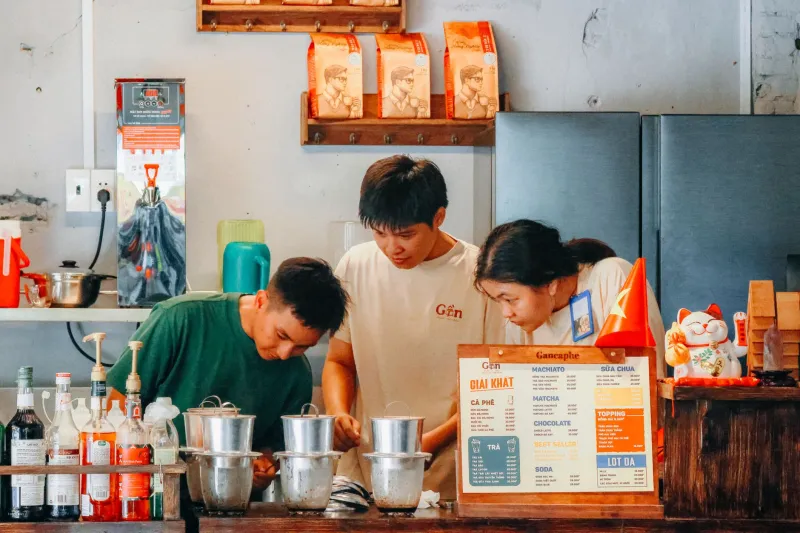
There's a particular kind of childhood memory that a lot of Vietnamese-Americans carry around without quite having words for it. You're seven years old, sitting on an overturned milk crate in the back of your parents' restaurant. You're doing homework under a flickering light. The dining room is full of noise — plates, voices, the hiss of the kitchen — and your parents are moving through it all like they were built for exactly this. You watch them. You don't realize you're watching them. But you are.
Years later, when someone asks where you got your work ethic, or your ability to stay calm under pressure, or your instinct to show up early and leave last — you might not immediately think of that milk crate. But it was there. It's always been there.
The Classroom Without Walls
Vietnamese-American parents, broadly speaking, are not a group known for sitting their kids down and delivering formal speeches about values. That's not really how it works. The transmission tends to happen sideways — through proximity, through observation, through the quiet accumulation of witnessed moments that only reveal their meaning much later.
A child who watches her mother manage a nail salon learns things that no business school teaches in the first semester. She sees how her mother handles a difficult customer without losing her composure. She watches the math happen in real time — the rent, the supplies, the hours, the tips. She absorbs, without anyone explaining it, that dignity and hard work are not always rewarded immediately, but that you show up anyway.
A son who spent his middle school afternoons helping his father stock shelves at a Vietnamese grocery store didn't just learn where the fish sauce goes. He learned that his father knew every regular customer by name. That his father stayed late when someone needed help. That his father treated the store not as a job but as a responsibility to the community it served.
These aren't abstract lessons. They're concrete, embodied, and they stick.
What Gets Absorbed Without Being Said
Child development researchers have a term for this kind of learning: observational or incidental learning. Kids absorb behavioral patterns from watching significant adults in their lives, often without any deliberate instruction happening on either side.
For Vietnamese-American children specifically, the content of what gets absorbed tends to cluster around a few recurring themes.
Sacrifice as a normal condition. Many Vietnamese-American parents worked — and continue to work — jobs that were physically demanding, socially invisible, or financially precarious. Their children watched this without being asked to. The lesson that gets internalized isn't "life is hard" in some defeated sense. It's more like: hard work is what people who love their families do. It's not heroic. It's just Tuesday.
Competence as a form of self-respect. Whether it was a father who could fix any piece of equipment in his shop or a mother who could calculate a customer's total in her head faster than the register could, Vietnamese-American kids often grew up watching their parents be genuinely, visibly good at what they did. That competence — regardless of the job's social status — modeled something important: that doing your work well is its own reward.
Community obligation woven into commerce. In family businesses especially, children saw that the business wasn't just for the family. It was for the neighborhood, for the extended community, for the people who depended on it. Credit extended to a customer who was having a hard month. A free meal given quietly to someone who needed it. These moments, witnessed but rarely discussed, planted seeds about what business actually means.
The Weight That Comes With It
It would be dishonest to talk about this kind of upbringing without acknowledging its complications.
Some Vietnamese-American adults describe feeling the weight of their parents' sacrifice as a kind of pressure they never asked for. When you've watched your mother work double shifts for years, the stakes of your own success feel different — higher, more loaded, more personal. Failure isn't just your failure. It can feel like a betrayal of everything that was poured into you.
That's a heavy thing to carry. And it doesn't always produce healthy outcomes. Perfectionism, burnout, difficulty accepting rest — these show up with real frequency in Vietnamese-American communities, and they're not unrelated to the lessons absorbed in those early years of watching.
The goal isn't to romanticize the inheritance. It's to understand it clearly enough to carry what's useful and set down what isn't.
Rewriting the Script
What's interesting about the current generation of young Vietnamese-Americans is that many of them are consciously examining what they absorbed and deciding, piece by piece, what to keep.
They're honoring the work ethic but questioning the martyrdom. They're carrying the community orientation but applying it to different causes. They're taking the resilience and the competence and the quiet ambition — and building lives with them that their parents might not have imagined, but that carry the same essential fingerprint.
A woman in her early thirties who grew up behind the counter of her parents' phở restaurant in Orange County put it this way: "I watched my parents work every single day of my childhood. I thought I was just bored back there. But now I run my own company and I realize — I learned everything. How to talk to people. How to stay calm when things go wrong. How to care about the people you serve. I learned it all at that restaurant and nobody ever taught me a single lesson."
The milk crate. The flickering light. The homework and the noise and the parents moving through it all.
It was always a classroom. We just didn't know it at the time.