The Country That Moved While You Were Gone
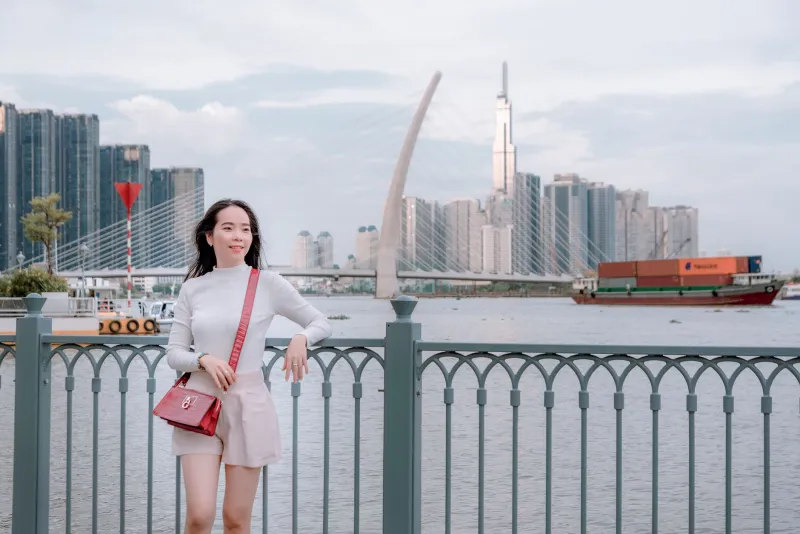
Anna Phương Trần had been building Vietnam in her head since she was six years old.
She built it from her mother's stories — the tamarind tree in the courtyard, the sound of motorbikes on Đồng Khởi at dawn, the way the light fell on the Mekong in the dry season. She built it from the photographs her aunt kept in a shoebox under her bed in San Jose. She built it from phở and bánh xèo and the particular homesickness she watched move across her parents' faces every Tết.
When she finally landed in Ho Chi Minh City at 28, after saving for two years to make the trip, she stood outside the airport in the heat and thought: This isn't it.
"It wasn't bad," she says carefully. "It was just — not the place I'd been living in for twenty-two years. The Vietnam in my head was a photograph. The Vietnam I was standing in was a city with skyscrapers and a Starbucks and twenty million people going somewhere fast."
She cried in her hotel room that first night. She's still not entirely sure what she was mourning.
The Journey Everyone Warned You About (But Not Like This)
The experience Anna describes has a shape that's become familiar to Vietnamese-Americans who make the trip back — whether for the first time or after decades away. The emotional arc tends to go something like this: anticipation, arrival, disorientation, grief, wonder, and then something more complicated that doesn't have a clean English name. Vietnamese has a word that gets close — bùi ngùi — a kind of bittersweet melancholy that holds loss and beauty at the same time.
For Vietnamese-Americans who were born in the U.S., the disorientation is about encountering a place they've only known as mythology. For those who left Vietnam as children or adults and are returning after twenty or thirty years, it's something different — the shock of finding that a place you remember has not been waiting for you. It kept going. It changed. It has opinions about its own future that have nothing to do with your memory of it.
Dr. James Lê, a psychologist in Orange County who works with Vietnamese-American clients, calls this "the myth gap." "People arrive expecting to fill in the gaps in their identity," he says. "What they find instead is that the gap is bigger and more complicated than they thought. The country they were looking for doesn't exist — not because it was never real, but because it was real in a specific moment in time that has passed."
What the Stories Left Out
Mark Nguyễn, 35, grew up in New Orleans. His parents left Việt Nam in 1979. They talked about it the way people talk about a place they loved deeply and left involuntarily — which is to say, they talked about it in amber. The Vietnam of his childhood was preserved, unchanging, perfect in its pain.
He went for the first time in 2019, on a two-week trip with his older sister. They went to Huế, where his family was from. They found the street his mother described. The house was gone — replaced by a pharmacy. The tamarind tree was gone. A woman about his mother's age was sitting in front of the pharmacy and looked at them with polite curiosity when they explained who they were looking for.
"She knew the family name," Mark says. "She knew the house. She said the family had moved away decades ago. She said it like it was the most ordinary thing in the world. And I guess it was. For her."
He called his mother from the street. She listened quietly. Then she said something he's thought about every day since: "The place is still there. It just doesn't need us anymore."
Vietnam Doesn't Know It's a Homeland
This is the thing that catches many Vietnamese-Americans off guard: Vietnam, as a living country, is not oriented toward its diaspora the way the diaspora is oriented toward it.
Hanoi and Ho Chi Minh City are young cities — median age in Vietnam is around 31 — humming with startup culture, K-pop, bubble tea, and a generation of Vietnamese people who are building something forward-facing and don't spend a lot of time thinking about 1975. The weight of that history, which Vietnamese-Americans often carry as a central fact of identity, is present in Vietnam but it sits differently there. It's history, not wound.
For Lisa Vũ, 41, who came to the U.S. as a baby and returned to Vietnam for a six-month work assignment in her late thirties, this was the most disorienting part. "I kept waiting to feel like I belonged," she says. "But Vietnamese people there didn't see me as Vietnamese. I spoke the language with a weird accent. I didn't know the cultural references. I dressed like an American. I was an American. And that was a strange thing to discover on the street where my grandmother was born."
She also found something she hadn't expected: genuine warmth, curiosity, and a kind of kinship that didn't require her to be the same. "Young Vietnamese people in Saigon were fascinated by me," she says. "Not because I was Vietnamese-American but because I was American and also Vietnamese. They thought that was interesting. They didn't think it was a problem."
The Third Thing
What tends to happen, for those who stay long enough, is the emergence of something that doesn't fit neatly into either the American self or the imagined Vietnamese self. Researchers who study diaspora identity call it "third culture" formation — the development of a perspective that belongs fully to neither the origin country nor the adopted one, but draws from both.
For Anna Phương Trần, the trip that began with tears in a hotel room ended three weeks later with something she calls "a kind of peace I didn't know I needed." She visited her grandmother's village in the Mekong Delta. She ate cơm tấm for breakfast every day. She got lost in District 1 and found her way back. She watched the city live its life, indifferent to her feelings about it, and found that indifference clarifying.
"Vietnam doesn't owe me anything," she says. "It doesn't owe me the version of itself that lives in my mom's stories. And when I stopped needing it to be that version, I could actually see what it was. Which was — incredible. Complicated. Real."
She's planning to go back. She's learning more Vietnamese. She's also, she says, done trying to close the gap between the two countries — the one in her head and the one on the map. She's decided to live in the space between them instead.
It's not the homeland her parents described. It's not America either. It's something she's still figuring out how to name.
Bùi ngùi, maybe. Bittersweet and true.