Two Clocks on the Wall: How Vietnamese-American Families Survive — and Celebrate — a Year That Never Quite Lines Up
Somewhere in a Vietnamese-American home right now, there are two calendars. One is the standard grid hanging near the refrigerator — the kind with coupons on the back and a picture of a mountain in Colorado. The other might be a small lunar calendar tucked near the family altar, its dates printed in Vietnamese, marking a rhythm that has nothing to do with January 1st or the third Thursday in November.
Living between these two systems is not just logistically complicated. It's emotionally layered in ways that can be hard to explain to coworkers, school administrators, or even second-generation kids who've grown up American enough to feel the pull of both worlds without fully belonging to either.
The Calendar Nobody Warned You About
The American holiday calendar is already a lot. Between Halloween candy negotiations, Thanksgiving travel chaos, Christmas gift anxiety, and New Year's Eve plans, most families are stretched thin from October through January. But for Vietnamese-American households, the year doesn't slow down after January 1st — it actually accelerates.
Tết, the Vietnamese Lunar New Year, typically falls in late January or February. Then comes the Ngày Ông Táo observance leading up to it, the ancestor remembrance days scattered through the year, Tết Trung Thu (the Mid-Autumn Festival) in the fall, and various regional or family-specific observances that don't make it onto any American holiday list.
None of these days come with a federal day off. None of them get a card aisle at Walgreens.
"My kids' school doesn't close for Tết," says one mother in the San Jose area who asked to be identified only as Chị Hoa. "So we stay up late the night before, we do the altar, we have the food — and then I'm driving them to school at 7:30 in the morning like nothing happened. It's exhausting. But we do it every year because if we don't, who will?"
The Negotiation Starts Early
For many families, the annual holiday juggling act begins with a quiet internal ranking: which celebrations are non-negotiable, which ones can be scaled back, and which ones have been quietly retired without anyone officially saying so.
Tết almost universally sits at the top of the list. It's the one Vietnamese holiday most families refuse to compromise on, even when it falls in the middle of a school week or clashes with a work deadline. Everything else gets arranged around it.
But the American holidays create their own gravitational pull — especially for kids who are watching their classmates count down to Christmas or who want to go trick-or-treating like everyone else on the block. Parents who grew up in Vietnam sometimes find themselves celebrating Halloween for the first time in their forties, not because they particularly care about it, but because their children do, and that matters.
"I never understood Thanksgiving until my daughter explained it to me," says one father in Houston, laughing. "Now we do both — Thanksgiving with turkey and then we also do cúng at the end of the month for the ancestors. My wife says the ancestors probably appreciate the turkey too by now."
What Gets Reimagined
Some of the most creative cultural work happening inside Vietnamese-American homes is invisible to everyone outside them. Families are quietly engineering hybrid observances that honor two traditions at once — not because it's trendy, but because it's the only way to keep everyone at the table.
Tết decorations go up alongside Christmas lights that haven't quite come down yet. Bánh chưng gets made in a kitchen that still smells like gingerbread. The Mid-Autumn Festival lantern walk happens in a suburban cul-de-sac instead of a village lane, kids in Halloween costumes one week and paper lanterns the next.
These aren't diluted traditions. They're adapted ones — and there's a difference worth honoring.
The emotional negotiation is harder to see. Older generations sometimes grieve what feels like the slow erosion of observances that once anchored entire communities. Younger Vietnamese-Americans sometimes feel guilty for not caring as deeply about certain rituals, or confused about why certain holidays feel more "real" than others.
What Gets Sacrificed
Let's be honest: not everything survives the merge.
Some families have quietly let certain ancestor observance days fade, not out of disrespect but out of sheer exhaustion. Some skip the full Tết preparation — the cleaning, the cooking, the specific foods — and replace it with a restaurant dinner and a red envelope exchange that takes twenty minutes instead of three days.
That's not failure. That's adaptation under pressure. And Vietnamese-American families have been adapting under pressure for a long time.
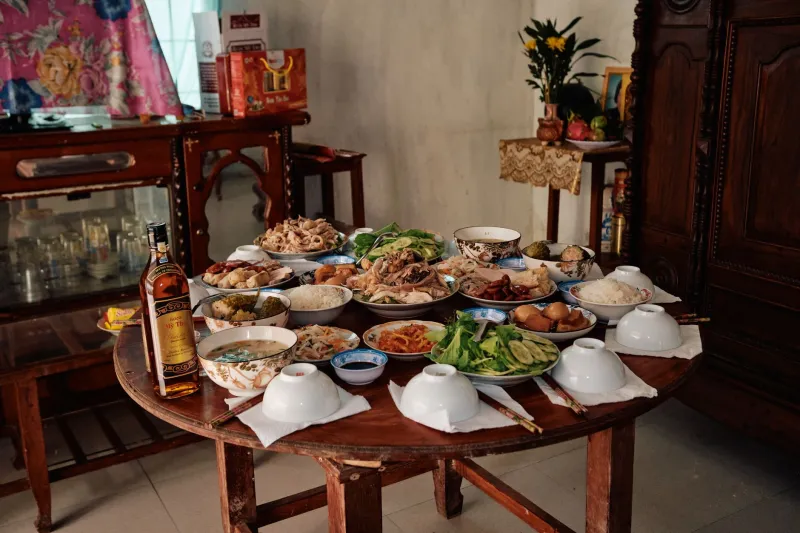
What tends to stay are the things that carry the most emotional weight: the altar, the food, the gathering of family, the act of pausing to remember where you come from. The outer trappings change. The core tends to hold.
Making Peace With the Double Life
The families who seem to navigate this most gracefully are the ones who've stopped trying to do everything perfectly and started doing everything intentionally.
That might mean choosing three Vietnamese observances to honor fully each year rather than half-heartedly observing ten. It might mean building a Tết dinner that doubles as a family reunion, so the gathering itself becomes the tradition rather than any specific ritual within it. It might mean telling kids directly: this is why we do this, this is what it means, this is why it matters to us even if your friends don't do it.
Chị Hoa, the mother in San Jose, puts it simply: "I don't need my kids to do everything the way my mother did it in Vietnam. I just need them to know that there is something to do. That there's a reason we light incense. That the calendar we follow has a history behind it."
Two clocks on the wall. Two sets of obligations, two sets of joys. For Vietnamese-American families, that's not a burden — it's just the shape of the year.