Lesson Plans With Hidden Roots: Vietnamese-American Teachers Bringing Their Culture Into Classrooms — One Story at a Time
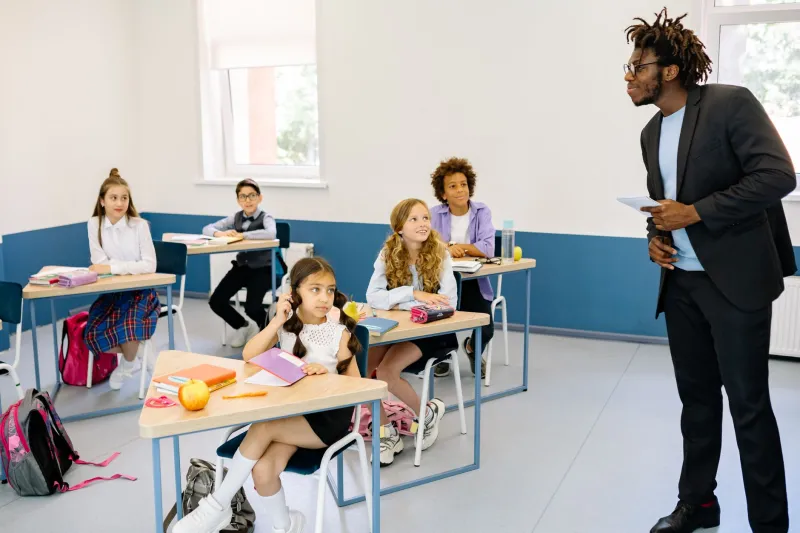
There's a moment Linh Phạm remembers clearly. She was standing at the front of her seventh-grade social studies class in San Jose, California, walking her students through a unit on immigration, when one of her Vietnamese-American students raised his hand and said, quietly, "My grandma came on a boat. Is that in here?" He was holding the textbook. The answer, of course, was no.
That was the moment Linh decided she was done waiting for the curriculum to catch up.
"I wasn't trying to make a political statement," she says. "I just looked at this kid's face and thought — his family's story is American history. Why isn't it in here?"
Linh is one of a growing number of Vietnamese-American educators across the country who are doing something quiet and significant: weaving Vietnamese history, literature, and lived experience into their classrooms without necessarily having official approval to do so. Not rogue, exactly. More like resourceful. They're finding the gaps in state standards, the elective units, the "choice reading" windows — and filling them with something that's been missing for decades.
The Curriculum Gap Nobody Talks About
For most American students, the Vietnam War — if it appears at all — shows up in a single chapter, filtered almost entirely through an American military lens. The fall of Saigon, the draft lottery, the protests at Kent State. What rarely makes it into print is the Vietnamese civilian experience, the refugee exodus, the communities that rebuilt themselves in places like Little Saigon in Orange County, Bolsa Avenue, or the Vietnamese neighborhoods of New Orleans and Houston.
Tuấn Nguyễn, a high school English teacher in the Houston Independent School District, noticed this absence early in his career. "My students — Vietnamese kids, but also Latino kids, Black kids, kids from refugee families of all kinds — they were reading books about other people's stories and never seeing their own," he says. "Literature is supposed to be a mirror. Theirs was blank."
Tuấn started small. He added The Sympathizer by Viet Thanh Nguyen as an optional independent reading for AP Literature students. Then he worked in Ocean Vuong's poetry during a unit on contemporary American voices. Neither required special approval — they fit neatly into existing standards about diverse American literature. But the effect in the classroom was immediate.
"A Vietnamese-American girl came up to me after class and said she'd never read anything that sounded like her family before. She was crying. I was barely keeping it together myself."
Smuggling Culture Without Losing the Complexity
Here's where it gets delicate, though. These teachers aren't interested in sanitizing Vietnamese history for easy classroom consumption. They're not swapping one flat narrative for another.
Mai Trần, who teaches elementary school in the Sacramento area, is careful about how she frames Vietnamese stories for her younger students. "I'm not going to stand up and say 'Vietnamese people are hardworking and resilient' and leave it at that," she says, a little sharply. "That's the model minority trap. That's a compliment that's also a cage."
Instead, Mai focuses on specificity — real people, real places, real decisions. For a unit on California communities, she brings in oral history recordings from the UC Irvine Southeast Asian Archive. She invites parents and grandparents to speak, in Vietnamese if they want, with student translators helping the class follow along. "When you hear an actual person describe leaving everything behind, it's not a stereotype anymore. It's a human being."
This attention to complexity extends to the war itself. Tuấn, at the high school level, is explicit with his students that the Vietnam War was experienced very differently depending on who you were, where you lived, and which side your family was on. "There's no single Vietnamese story about the war," he says. "There are millions. My job is to make sure students understand that — not to replace one oversimplification with another."
Working the System From the Inside
None of these teachers describe what they're doing as rebellion. If anything, they're meticulous about working within the framework — finding standards their additions satisfy, documenting outcomes, building allies among department heads and principals.
"I always make sure I can show you exactly which standard I'm hitting," Linh says with a laugh. "It's like... I know the rules of the game, so I play the game well. And then I also teach the thing I needed to teach."
This inside-game approach is strategic. Several of these educators have watched colleagues try to push cultural content through official channels — submitting proposals to curriculum committees, lobbying for new required texts — and seen those efforts stall for years. Working organically, finding the elbow room inside existing frameworks, tends to move faster.
That said, a few have managed to create more formal change. Linh helped develop a supplemental unit on Vietnamese-American history that's now used in several San Jose Unified schools. Tuấn has been invited to present at professional development days for other teachers in his district. Small wins, but they add up.
What the Students Carry Out
The impact isn't just on Vietnamese-American students, though the effect there can be profound. Non-Vietnamese students often describe these units as the first time they understood the refugee experience as something real and close rather than distant and historical.
"I had a white student — sweet kid, very earnest — who came to me after we did the oral history project and said, 'I didn't know Vietnamese people were still alive from the war,'" Tuấn recalls, shaking his head. "He meant it sincerely. That's not his fault. That's what happens when the curriculum stops the story in 1975."
For Vietnamese-American students, the effect runs deeper. There's something that happens when a teenager sees their family's history treated as worthy of serious academic attention — not as a footnote, not as a trauma narrative, not as a feel-good immigration success story, but as layered, complicated, real American history. They sit up a little differently. They ask different questions.
Mai puts it simply: "I want my students to know that their people made this country too. Not just in spite of hardship. Because of who they are."
The Long Game
These teachers know they're playing a long game. Curriculum change is slow. Administrative support is inconsistent. And the pressure to "just teach to the test" is real, especially in underfunded districts where these educators often work.
But there's something sustaining about it, too. Linh talks about feeling like she's doing the work that her own teachers couldn't do for her — filling in the blank she stared at as a kid, when she looked in the textbook mirror and saw nothing looking back.
"I'm not waiting for permission," she says. "I waited long enough."
And in classrooms from San Jose to Houston to the suburbs of Northern Virginia, lesson by lesson, book by book, a story that was always American is finally getting told.