When the Kids Become the Translators: The Beautiful, Messy Language Loop Inside Vietnamese-American Homes
Mia Nguyen was eleven years old the first time she had to explain what a "deductible" was to her mother.
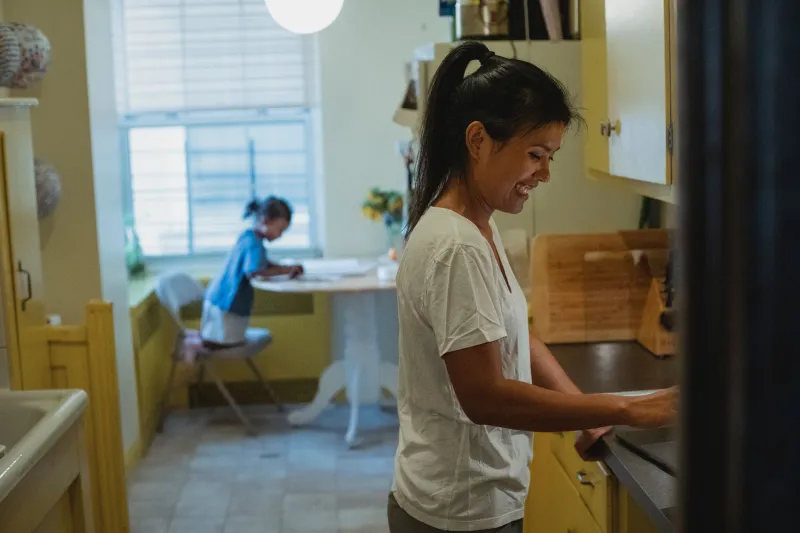
She didn't fully understand it herself. She'd looked it up on her school Chromebook during lunch, scribbled a rough definition on a napkin, and rehearsed it on the bus ride home. That evening, sitting at the kitchen table in their San Jose apartment with a stack of insurance forms between them, Mia walked her mom through it — slowly, in a mix of English and Vietnamese, pointing at numbers and nodding a lot.
"She trusted me," Mia, now 22 and a junior at UC Davis, said with a small laugh. "Which was kind of terrifying, honestly."
This scene — or some version of it — plays out in Vietnamese-American homes from Houston to Garden Grove to Falls Church every single day. Children translating for parents at doctor's offices, parent-teacher conferences, DMV counters, and HR departments. Parents, in turn, correcting their kids' Vietnamese tones, insisting on proper honorifics, and keeping alive a language that the American school system has little interest in preserving.
It's a two-way exchange that researchers are only beginning to fully understand — and one that carries far more emotional weight than most families talk about out loud.
The Reversal Nobody Planned For
In traditional Vietnamese family structure, elders hold authority. Parents teach. Children learn. Respect flows in one direction: upward. But immigration scrambles that script in ways nobody fully prepares for.
Dr. Linh Pham, a psychologist based in Orange County who works primarily with Vietnamese-American families, calls it "role reversal stress" — and she's careful to point out that it cuts both ways.
"The child feels the weight of being responsible for their parent in adult situations they're not equipped for," she explained. "And the parent, who has always been the authority figure, suddenly feels dependent on their kid. That's a profound shift in identity for both of them."
For many first-generation Vietnamese immigrants who arrived in the U.S. as adults — whether in the post-1975 wave or more recent decades — English language acquisition is a constant, grinding effort. Work, survival, and the sheer exhaustion of building a new life from scratch often leave little room for formal classes. Their kids, meanwhile, are immersed in English eight hours a day at school and absorb it the way children absorb everything: effortlessly, and almost entirely.
The result is a household where the youngest members are often the most fluent in the dominant language of the country they all call home.
More Than Just Words
What makes this dynamic so layered isn't the language itself — it's everything the language carries.
Twenty-six-year-old Kevin Tran, who grew up in a Vietnamese enclave in Houston's Midtown, remembers acting as his father's interpreter at job interviews when he was in middle school. "I'd be sitting in the waiting room translating his answers in my head before he even said them," he said. "I wanted him to sound confident. I wanted them to see what I saw."
That desire — to represent a parent faithfully and with dignity — is something many second-generation Vietnamese-Americans describe with striking consistency. There's pride in it. But there's also pressure, and sometimes, grief.
"You're a kid," Kevin added. "You don't have the vocabulary for half the things you're being asked to explain. And you're terrified of getting it wrong."
On the flip side, Vietnamese parents are often the ones holding the cultural and linguistic thread that their American-born children desperately need — even if those kids don't fully realize it yet.
Hoa Bui, a Vietnamese language teacher at a weekend heritage school in the DC metro area, has watched this dynamic evolve over two decades of teaching. "The parents come to me sometimes and say, 'My daughter corrects my English in front of her friends.' And I have to ask them: do you correct her Vietnamese?" She paused. "Usually the answer is no. They've stopped. They think it doesn't matter anymore. But it does."
Code-Switching as a Superpower (and a Survival Skill)
For Gen Z Vietnamese-Americans, moving fluidly between English and Vietnamese — often mid-sentence — isn't just a quirk. It's a form of fluency all its own.
Linguists call it code-switching. Vietnamese-American families just call it talking.
"I'll say something like, 'Con đi học về rồi, Mom, can you unlock the door?'" said 19-year-old Jade Phan from San Diego, laughing. "It's just natural. It's how my brain works."
But code-switching also functions as a kind of cultural bridge maintenance. When Jade slips Vietnamese words into conversation, she's not just being efficient — she's keeping a language alive in her own mouth, in her own daily life, in a way that no formal class can fully replicate.
Dr. Pham sees this as genuinely significant. "These kids are doing something extraordinary without realizing it. They're holding two worlds together simultaneously. That requires a kind of cognitive and emotional flexibility that most monolinguals never develop."
And increasingly, employers are noticing. Vietnamese-American young adults who grew up as household translators often enter the workforce with unusually strong communication skills — the ability to read a room, simplify complex information, and bridge cultural gaps. It's a résumé line that doesn't exist, but probably should.
The Emotional Weight Nobody Talks About
For all its richness, the language loop inside Vietnamese-American families can also be quietly painful.
Mia, looking back on those insurance forms and DMV trips and medical appointments, is proud of what she did for her family. But she also acknowledges something else. "There were times I felt like I couldn't just be a kid," she said. "Like I had to be an adult because my parents needed me to be."
Dr. Pham emphasizes that this experience — sometimes called "parentification" — doesn't have to be traumatic, but it does need to be acknowledged. "When families can talk about it openly — when parents can say 'thank you, that was a lot to ask of you' — it changes everything. The burden becomes a bond."
That conversation doesn't always happen in Vietnamese-American households, where emotional directness isn't always the norm. But it's happening more, especially as the second generation grows up and starts processing their childhoods with new perspective.
Kevin Tran, now working in tech in Austin, said his father recently brought it up out of nowhere during a phone call. "He said, 'I know I leaned on you too much when you were young.' Just like that. I didn't know what to say." He paused. "I think I just said, 'Ba, it was fine.' But it meant everything."
A Loop, Not a Hierarchy
Maybe the most honest way to describe what happens in these households is this: it's not a reversal of roles so much as a dissolution of them. Parents and children become collaborators in a shared project of belonging — each teaching the other what they know, each learning what the other holds.
Vietnamese parents pass down tones, traditions, and the kind of cultural knowledge that can't be Googled. Their kids pass back the English phrases, the American systems, the tools for navigating a world their parents built a life in but never fully mapped.
It's imperfect. It's sometimes exhausting. And it's one of the most quietly beautiful things happening inside immigrant families across this country.
At Làng Ơn Pô, we've always believed that community isn't built in one direction. It's built in loops — in the back-and-forth, the give-and-take, the moments where the teacher and the student are the same person.
Mia said it best: "My mom still corrects my Vietnamese. I still help her with her emails. We're both still learning. I think that's just how it works."
Yeah. That's exactly how it works.