Play It Again, Bà Nội: The Vietnamese-American Families Passing Down Music One Song at a Time
There's a particular kind of silence that falls over a car when a Vietnamese parent changes the radio station. One second, a kid's got their favorite pop song blasting. The next, a trembling, ornamented melody fills the speakers — something ancient and unfamiliar, somewhere between opera and a lullaby. The parent glances over. The kid stares out the window.
And sometimes — not always, but sometimes — the kid quietly asks, "What is that?"
That question is everything.
For Vietnamese-American families scattered across cities like San Jose, Houston, New Orleans, and Philadelphia, music is one of the most personal — and most complicated — threads connecting the old world to the new. It's not just about taste. It's about memory, loss, identity, and the stubborn hope that something essential won't get left behind.
The Tape That Started It All
Linh Trương, a 42-year-old mother of three in Garden Grove, California, still has a shoebox of cassette tapes her own mother brought over from Vietnam in the late 1980s. Most of them are worn thin from decades of rewinding. Several are labeled in fading handwriting — Khánh Ly, Thái Thanh, Chế Linh.
"I didn't appreciate them when I was a teenager," she admits with a laugh. "I thought it was embarrassing. We'd be driving to the mall and my mom would have this music going — so dramatic, so slow — and I just wanted to disappear."
Now she plays those same recordings for her own kids.
"My youngest, she's nine, she actually asked me to put on 'Diễm Xưa' last month while she was doing homework. I almost cried. I didn't make a big deal of it because I didn't want to scare her off. But inside I was losing it."
That song — a 1960 composition by legendary musician Trịnh Công Sơn — has been described as the Vietnamese equivalent of a timeless classic. It's the kind of piece that carries entire lifetimes inside it. That a nine-year-old in Southern California chose it voluntarily feels, to her mother, like a small miracle.
What Even Is "Vietnamese Music"?
Here's the thing: there's no single answer to that question, and that's kind of the point.
Traditional Vietnamese music spans everything from nhạc dân tộc (folk and classical forms) to cải lương (southern Vietnamese opera), quan họ (northern call-and-response folk singing), and nhã nhạc (court music from the Huế dynasty, now a UNESCO-recognized art form). Then there's the nhạc vàng era — the sentimental, often bittersweet pop ballads that dominated South Vietnam before 1975 and became the emotional soundtrack of the diaspora. And today, V-pop — slick, Korean-influenced Vietnamese pop — is exploding globally, pulling in a whole new generation.
For Vietnamese-American parents, choosing what to pass down often says as much about their own history as it does about their kids' future.
Tuấn Nguyễn, a musician and music teacher based in Houston who runs weekend Vietnamese cultural workshops for kids, puts it plainly: "What I hear from parents most is that they don't know where to start. They feel like they have to defend the music before their kids even hear it. But that's the wrong move. Just play it. Let it happen."
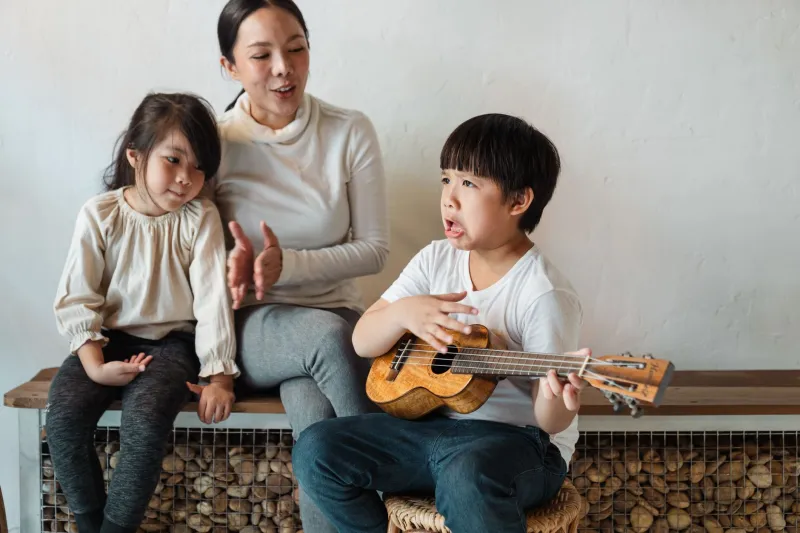
His approach in class is deliberately low-pressure. He'll introduce the đàn tranh (a 16-string zither) or the đàn bầu (a single-string instrument with an eerie, haunting tone) by letting kids touch them first, make noise, ask dumb questions. No reverence required.
"Kids don't need to be told something is important. They just need to be around it long enough to decide for themselves."
The V-Pop Bridge
Not every family is starting from folk instruments and classical opera. For a lot of Vietnamese-American households, the gateway drug is V-pop — and parents are surprisingly okay with that.
My Lê, a 38-year-old mom in the Dallas area, started a shared Spotify playlist with her teenage daughter two years ago. The deal: they each add songs, no vetoing allowed.
"She puts on SOOBIN, Tlinh, all the current stuff. I add some older Mỹ Tâm, some Lam Trường from the 2000s. And slowly I started sneaking in some Khánh Ly. She didn't even notice at first."
Her daughter, 15-year-old Jade, is now deep into a rabbit hole of pre-1975 Vietnamese music she found on YouTube. "I don't understand all the words yet," Jade says. "But it feels like... I don't know, like homesickness for a place I've never been? Is that weird?"
It's not weird. It's actually a well-documented phenomenon — sometimes called diasporic nostalgia, a longing for a cultural homeland experienced secondhand, through the memories and emotions of your parents and grandparents. Music, maybe more than any other art form, is a direct line into that feeling.
When Grandma's the DJ
Sometimes the bridge between generations isn't a parent at all — it's a grandparent who simply refuses to turn the volume down.
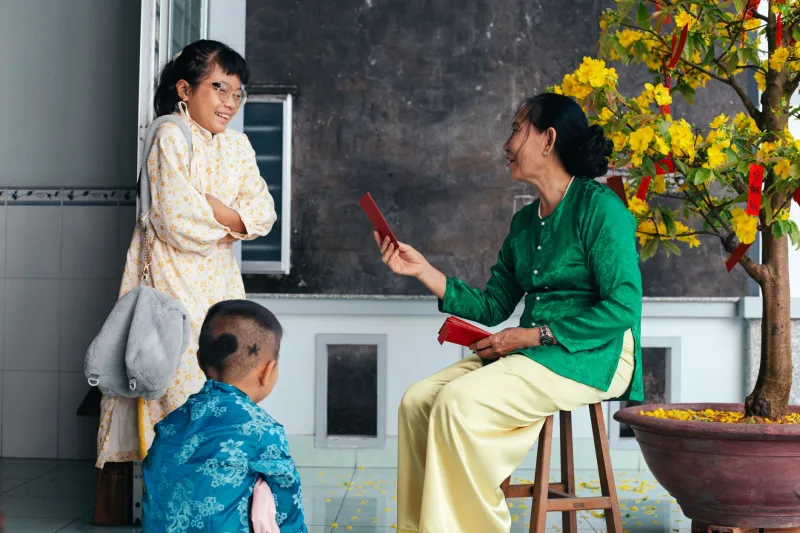
In a multigenerational household in San Jose, 71-year-old Bà Nội Phương has a standing Saturday morning ritual: cải lương at full blast while she cooks. Her grandchildren, ranging in age from 8 to 16, used to groan. Now the 16-year-old, Kevin, has started recording clips on his phone.
"He told me he uses it for a school project," she says through a translator, smiling. "But I think he just likes it."
Kevin, for his part, is more guarded. "It's kind of fire, honestly. Like, the vocal runs are crazy. I played some for my friends and they thought it was cool."
His grandmother doesn't know what "fire" means in this context. But she knows he keeps showing up in the kitchen on Saturday mornings.
No Pressure, Just Presence
Every family interviewed for this piece had a version of the same piece of advice: don't force it.
Music shared under pressure — as a cultural obligation, as a guilt trip, as a "you need to know this" lecture — tends to bounce off. Music that just exists in the background of a life, playing in the car, drifting from another room, humming from a grandparent's phone — that music has a way of sneaking in.
Linh Trương, back in Garden Grove, puts it best: "I'm not trying to make my kids Vietnamese. They already are. I'm just trying to make sure they know what that sounds like."
Somewhere in a shoebox, a cassette tape is waiting to be played again. And somewhere in a kid's memory, a melody is taking root — one they'll probably hum to their own children someday, not even knowing where they first heard it.
That's how it works. That's how it's always worked.