Shrines in Small Spaces: How Vietnamese-Americans Are Keeping Ancestral Altars Alive — On Their Own Terms
There's a shelf in Linh Trần's San Jose apartment that most visitors probably assume is just a really thoughtful bookcase. A framed black-and-white photo. A small ceramic cup. A single stick of incense in a holder the size of a thumb. A tangerine.
But Linh knows exactly what it is. So does her grandmother — who lives in Ho Chi Minh City and video calls every Sunday to make sure the fruit is fresh.
"She zooms in on it," Linh, 29, laughs. "Like, she'll literally ask me to pan the camera. She wants to see the altar."
This is what ancestor veneration looks like in 2025: a sacred tradition compressed into a corner of a 650-square-foot apartment, held together by FaceTime, filial love, and a determination not to let something essential get lost in the move to American life.
What the Altar Actually Means
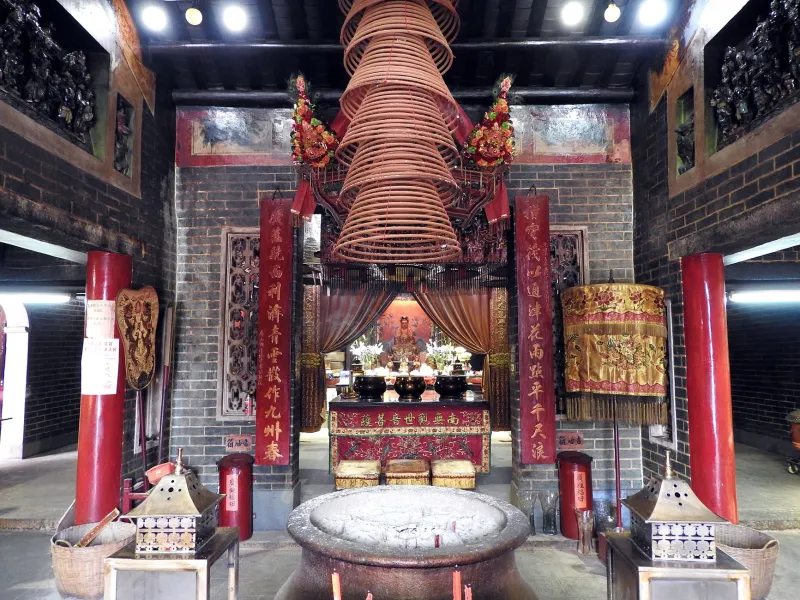
For those outside the tradition, the bàn thờ — the ancestral altar — can look like decoration. But within Vietnamese culture, it's closer to a living relationship. The altar is where the dead are not so much remembered as present. Offerings of food, incense, and fruit aren't symbolic gestures — they're acts of care extended across the boundary between worlds.
The practice draws from a blend of Confucian values, Buddhist belief, and folk spirituality that has shaped Vietnamese family life for centuries. At its core is a simple idea: you owe your existence to those who came before you, and that debt doesn't end when they die.
"In Vietnam, the altar is usually the first thing you see when you walk into a home," says Hương Nguyễn, a cultural anthropologist at UC Santa Barbara who studies Vietnamese diasporic identity. "It's prominent. It's central. It says something about who this family is and where they come from."
In America, that centrality is harder to maintain — and for many families, the altar has quietly shrunk, shifted, or disappeared altogether.
The Apartment Problem
Space is the most obvious challenge. A traditional altar can be an elaborate piece of furniture — lacquered wood, multiple tiers, a dedicated wall. That works in a family home in Garden Grove or Houston's Midtown. It doesn't work as easily in a studio in Brooklyn or a shared house in Austin where three roommates split the rent.
But Vietnamese-Americans are nothing if not adaptable.
Khoa Phạm, 34, grew up in a New Orleans family where the altar dominated the living room. When he moved to Chicago for work, he spent months feeling vaguely guilty about not having one. "I didn't even know how to set one up myself — my mom always did it," he admits. "I just knew I was supposed to have it."
He eventually built something modest: a floating shelf, a photo of his late grandfather, incense, a small vase. He looked up the basics online. He texted his mom questions. It took time, but he got there.
"It's not what we had at home. But it's real," he says. "I feel it when I light the incense. That part doesn't change."
This kind of scaled-down, figure-it-out approach is increasingly common among younger Vietnamese-Americans — and it's sparking a broader conversation about what counts as "doing it right."
Digital Altars and New Rituals
Some families have taken the adaptation even further. In the wake of the COVID-19 pandemic, when travel was impossible and in-person mourning rituals were disrupted, a number of Vietnamese-American communities began experimenting with digital memorial spaces — online platforms where photos, videos, and tributes could be gathered and revisited.
Some temples and cultural organizations set up shared virtual altars during Tết. Families created private group chats dedicated to honoring specific ancestors, lighting incense together over video call.
My Lê, a 26-year-old graphic designer in Atlanta, created a digital scrapbook for her late grandmother after she passed during the pandemic. "We couldn't fly back. We couldn't do the ceremony the way we wanted to," she says. "So I made this thing online — photos, voice memos she'd sent me, recipes she'd written down. I visit it on her birthday and on the anniversary."
She pauses. "I don't know if it's an altar exactly. But it feels like one."
Hương Nguyễn sees this kind of improvisation as consistent with the tradition's deeper logic. "Ancestor veneration has always been adaptable," she points out. "Vietnamese people brought it through colonization, through war, through displacement. The form changes. The intention doesn't."
Navigating Secular Spaces — and Skeptical Roommates
Not every challenge is logistical. For some Vietnamese-Americans, especially those raised in more secular households or who've moved away from religion, the altar sits at an awkward intersection of belief and cultural obligation.
Tuấn Vũ, 31, identifies as agnostic. He grew up in a household where the altar was present but rarely explained. "Nobody told me what I was supposed to believe," he says. "I just knew we did it."
Now, living with a non-Vietnamese partner in Portland, he keeps a small altar in the bedroom — a decision that came with its own negotiations. "My partner was curious, not dismissive," he says. "But I had to be able to explain it, which meant I had to figure out what it meant to me."
What he landed on: the altar isn't about literal belief in spirits. It's about gratitude. About continuity. About refusing to let the people who shaped you disappear entirely.
"I can hold that," he says. "Even without the metaphysics."
This kind of secular reinterpretation is becoming more visible in Vietnamese-American communities — and it's not without tension. Older generations sometimes see it as dilution. Younger practitioners push back: they argue that finding their own relationship to the tradition is the only way to keep it alive at all.
What Gets Passed Down
For Linh Trần, the altar on her bookshelf has become something unexpected: a conversation starter with herself.
"I never knew much about my great-grandparents," she says. "Having the altar made me want to find out. I started asking my parents questions I'd never asked before. My mom pulled out old photos I'd never seen."
The altar, in other words, became a door — not just to the past, but to a living family history she'd been too busy to explore.
That's the thing about ancestor veneration that gets lost when it's reduced to ritual: it's also just a practice of paying attention. Of asking who came before you, what they carried, and what you're carrying forward.
In apartments and shared houses across America, on shelves and screens and floating wall brackets, Vietnamese-Americans are figuring out how to keep that question alive.
The incense burns for a few minutes. The tangerine sits a little longer. And somewhere on a Sunday video call, a grandmother in Ho Chi Minh City zooms in to check.
Some things, it turns out, don't need to be translated.