Making Tết Our Own: How Vietnamese-American Families Are Bending Tradition Without Breaking It
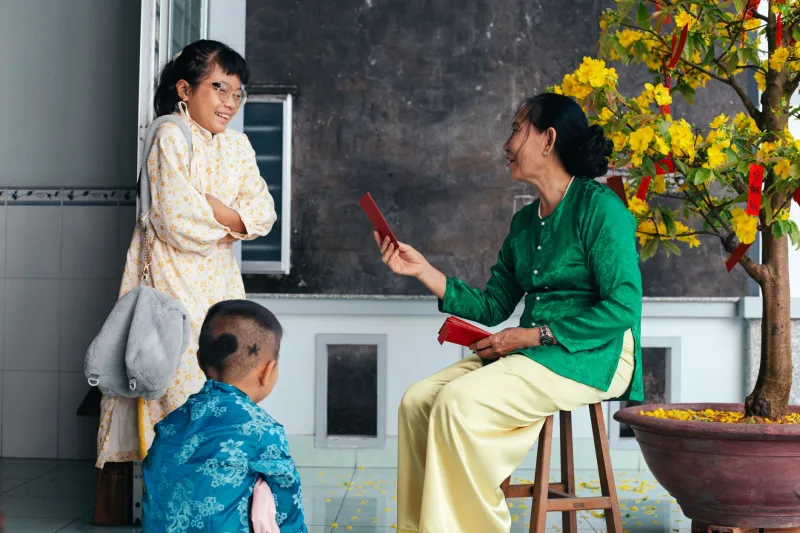
Somewhere between a grocery run to the nearest 99 Ranch and a FaceTime call with grandparents in Hội An, a Vietnamese-American family in San Jose is setting up their altar for Tết. The fruit tray might not be the perfect five-fruit mâm ngũ quả their grandmother would approve of — but there's a mango, some oranges, and a pineapple someone grabbed last-minute. The incense is lit. The red envelopes are ready. And somehow, it still feels like Tết.
That tension — between doing it "right" and doing it real — is something a lot of Vietnamese-American families know intimately. And increasingly, the conversation is shifting. Rather than measuring celebrations against an idealized homeland version of the holiday, diaspora families are asking a different question: What does Tết mean to us, here, now?
The Altar Doesn't Have to Be Perfect
For many Vietnamese families, the ancestral altar is the spiritual center of Tết. It's where offerings are made, incense is burned, and the connection between the living and the ancestors is renewed. But maintaining a traditional altar in, say, a one-bedroom apartment in Chicago comes with real logistical challenges.
Thuy Nguyen, a second-generation Vietnamese-American living in the Chicago suburbs, grew up watching her parents maintain an elaborate altar with fresh flowers, specific fruits, and carefully prepared dishes changed out daily during the holiday. When she moved into her own place, she wanted to continue the practice — but on her own terms.
"I don't have a dedicated room for it the way my parents did," she says. "So I use a shelf on my bookcase. I keep a small photo of my grandparents, a candle, and I always make sure I have chrysanthemums if I can find them. It's simpler, but it's mine."
Cultural educators and community elders across Vietnamese-American communities are increasingly supportive of this kind of adaptation. The underlying intention — remembering ancestors, inviting good fortune, expressing gratitude — matters far more than the specific arrangement of objects on a shelf.
Cooking Across the Distance
Food is arguably the most visceral thread connecting Vietnamese-Americans to Tết. The smell of bánh chưng steaming for hours, the sticky sweetness of mứt, the careful preparation of thịt kho — these are sensory memories that can stop a person mid-grocery-aisle.
But making traditional Tết food in an American kitchen, often without the extended family network that traditionally shares the labor, is genuinely hard. Some families have found creative workarounds. Group chats become recipe archives. Aunts in different states mail homemade mứt to nieces who can't find it locally. Vietnamese grocery stores in cities like Little Saigon in Westminster, California, or Eden Center in Falls Church, Virginia, do brisk business in pre-made holiday staples.
And then there are the hybrid menus — tables that hold both canh khổ qua and a store-bought rotisserie chicken, because that's what the kids will actually eat and nobody has time to fight about it on New Year's Day.
Phong Tran, who runs a Vietnamese cultural cooking class in Atlanta, sees this kind of blending as evolution, not compromise. "Food traditions were never static, even in Vietnam," he says. "Every region had its own version of Tết food. What we're doing here is just adding another chapter."
When the Family Spans Time Zones
One of the quieter logistical realities of Tết in the diaspora is that "family reunion" often means coordinating across multiple American cities — and sometimes multiple continents. A family dinner might involve relatives dialing in from Houston, Portland, and Hanoi simultaneously.
Rather than treating this as a diminished version of the real thing, many families have started leaning into the format. Designated video call windows during the holiday. Shared photo albums that get updated throughout the week of celebrations. Group cooking challenges where different households make the same dish and compare results.
Some community organizations have even started hosting virtual Tết events that bring together Vietnamese-Americans who might be geographically isolated — single adults in smaller cities, elderly community members who can't travel — giving them a place to celebrate with others.
Teaching the Next Generation Without Pressure
For Vietnamese-American parents raising kids who were born here, Tết carries an extra layer of meaning: it's one of the most powerful tools for cultural transmission available to them. But there's a real risk of turning something joyful into something that feels like homework.
Many families are finding that the key is invitation over obligation. Letting kids help fold dumplings instead of making them watch. Explaining the meaning behind lì xì red envelopes in a way that connects to something they already care about. Watching Vietnamese New Year content together online. Making the decorations a craft project rather than a chore.
"My daughter is eight and she's obsessed with the lion dance," says Mỹ Lê, a mother of two in Dallas. "She doesn't care about half the other stuff yet, but that one thing? She'll remember it. And that's the thread. You just need one thread."
The Village Doesn't Have to Be Literal
The name Làng Ơn Pô — a nod to the village, the place of belonging and memory — resonates deeply when you think about what Tết actually is at its core. It's not a checklist of rituals. It's a gathering of people who share something, whether that's blood, language, culture, or simply the desire to hold onto something meaningful.
Vietnamese-American families across the country are proving that the village can exist in a Houston living room, a Seattle community center, a group chat with forty-seven members, or a bookcase shelf with a candle and some chrysanthemums.
Tết doesn't need to look the same to feel the same. The warmth is portable. So is the meaning. And that, maybe, is the most Vietnamese thing about it.