Threads of Identity: How Gen Z Vietnamese-Americans Are Rewriting the Rules of Áo Dài
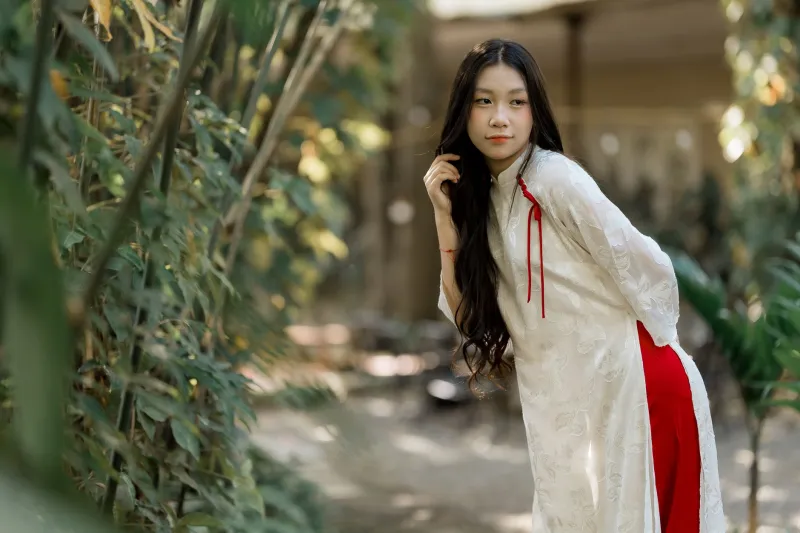
There's a video making the rounds on TikTok. A young woman in a cropped áo dài paired with wide-leg linen trousers twirls in front of a pastel-pink backdrop, the comment section flooding with heart emojis and questions like "Where did you GET that?" and "Omg this is so beautiful I want one."
The creator is Linh Nguyễn, a 23-year-old Vietnamese-American from San Jose, California, who started sewing her own áo dài variations two years ago out of frustration. "Every time Tết came around, I'd go to the store and the options were either really formal and stiff or kind of cheaply made," she says. "I wanted something that felt like me. Something I could actually wear to a family party and then maybe to brunch the next morning."
Linh is far from alone. Across the country — from Houston's massive Vietnamese community to pockets of the diaspora in Atlanta, Seattle, and Philadelphia — young Vietnamese-Americans are picking up scissors, sewing machines, and embroidery hoops to reclaim a garment that's been central to Vietnamese cultural identity for centuries.
What the Áo Dài Actually Is (And Why It Matters)
For anyone who grew up outside the community, a quick primer: the áo dài (pronounced roughly "ow yai" in the south, "ow zai" in the north) is Vietnam's national garment, a long fitted tunic worn over wide-legged trousers. It's elegant, deliberate, and deeply symbolic — associated with everything from formal ceremonies and school uniforms to wedding processions.
But in the diaspora, the áo dài has historically occupied a complicated space. For many first-generation immigrants, it's a garment of memory — something worn on special occasions, stored carefully in plastic, and pulled out for Tết or weddings. For their American-born kids, it could sometimes feel like a costume rather than clothing. Something beautiful, but not quite theirs.
That dynamic is shifting fast.
Designers Doing It Differently
Mikey Trần, who goes by @mkytran on Instagram, runs a small atelier out of Garden Grove, California — the heart of Orange County's Vietnamese-American community. His designs are hard to categorize in the best way possible: áo dài silhouettes in bold geometric prints, asymmetrical hemlines, and unexpected fabric choices like Japanese selvedge denim and deadstock silk from LA's garment district.
"People always ask me if I'm worried about being disrespectful," Mikey says with a laugh. "And I get it. But I always say — who do you think was modernizing the áo dài in Saigon in the 1960s? Young people. Designers. That's always how fashion works."
He's got a point. The áo dài itself has evolved dramatically over the centuries, shaped by Chinese influence, French colonialism, and regional Vietnamese aesthetics. The form we recognize today was largely standardized in the 1930s — itself a modernization.
Mikey's clients range from grandmothers wanting a custom fit to college students ordering pieces for cultural showcases at their universities. "I've had a girl come in with her mom and her grandma, three generations picking fabrics together," he says. "That's the whole point."
TikTok as a Cultural Runway
Social media has been genuinely transformative for this movement. Vietnamese-American creators have turned platforms like TikTok and Instagram into something like a distributed fashion week — sharing styling tips, fabric sourcing videos, and even live sewing sessions that draw thousands of viewers.
Thảo Phạm, a 21-year-old pre-med student at UC Irvine, started posting áo dài content almost by accident. "I wore one to my university's Lunar New Year event and people kept asking about it in the comments," she says. "So I made a follow-up video and it just blew up."
What surprised her was how many non-Vietnamese viewers responded. "I had Korean-American girls, Filipina girls, Mexican-American girls — all saying this inspired them to wear their own traditional clothes more. That felt really special."
This cross-cultural resonance is something designers and community organizers are paying close attention to. The áo dài renaissance isn't just a Vietnamese-American story — it's part of a broader Gen Z movement pushing back against the flattening effect of fast fashion and reclaiming heritage clothing as a form of identity expression.
The Tension Between Honoring and Innovating
Not everyone is fully on board, and that's worth acknowledging. Some older community members feel uneasy when the garment is cropped, dyed in unconventional colors, or styled in ways that depart significantly from tradition. The conversations happening in Vietnamese-American Facebook groups and community centers can get heated.
"My grandma was not sure about my designs at first," admits Linh Nguyễn. "She thought I was making fun of something sacred. But then she saw how many young people were actually wearing them, actually caring about them — and she came around. She even helped me with some of the embroidery."
Designer Mikey Trần believes the key is intention and education. "I always include context with my work. I talk about where the garment comes from, what it means. Innovation without knowledge is just appropriation of your own culture, you know?"
The best designers in this space seem to hold both things at once: a deep reverence for what the áo dài represents and a genuine excitement about where it can go.
Wearing It Beyond the Holiday
Perhaps the most radical thing happening in this space is the simplest: young Vietnamese-Americans are wearing áo dài outside of formal occasions. To coffee shops. To art galleries. To class.
For Thảo, that's the whole point. "If we only wear it twice a year, it stays a costume. But if it's just part of how we dress, it becomes part of who we are."
That shift — from ceremonial object to living garment — might be exactly what ensures the áo dài's place in Vietnamese-American identity for the next generation. Not preserved in plastic, but worn, washed, altered, loved, and passed down.
And maybe filmed for TikTok along the way.