The Language Beneath the Language: How Vietnamese-American Families Communicate Everything Without Saying a Word
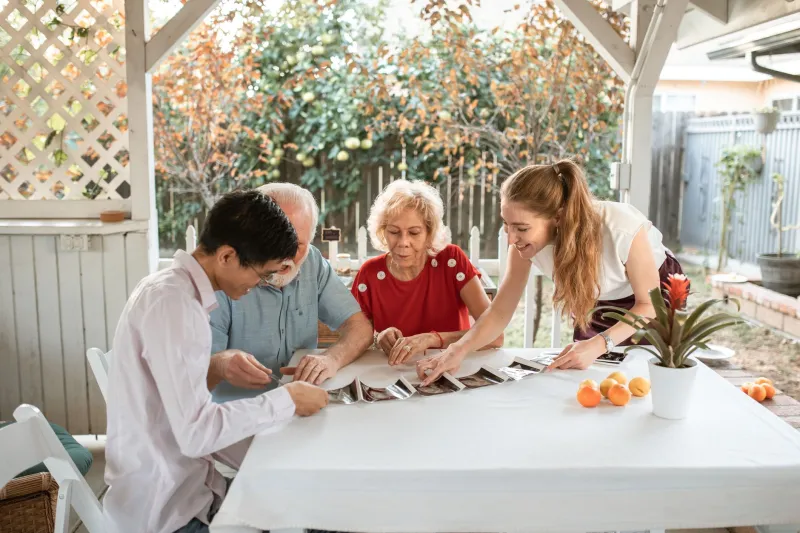
You're at a family gathering. Your grandmother hasn't said anything to you directly. She hasn't corrected you or praised you or given you any instruction. But you know — somehow, with complete certainty — that she noticed you didn't greet your aunt properly when you walked in. You know because of the way she looked at you. Not a glare. Not a frown. Just a look that contained a full paragraph.
If you grew up in a Vietnamese-American household, you probably know exactly what that look feels like. You also know that explaining it to someone outside the culture is nearly impossible.
This is the language beneath the language — the dense, efficient, emotionally loaded system of non-verbal communication that runs parallel to spoken Vietnamese and English inside Vietnamese-American families. It doesn't get taught explicitly. It gets absorbed. And for many Vietnamese-Americans navigating life between two cultures, it's one of the most significant — and least discussed — parts of their identity.
What the Body Already Knows
All cultures have non-verbal communication norms. But the specific grammar of Vietnamese non-verbal communication carries particular weight because it's so tightly tied to hierarchy, respect, and relational obligation — concepts that are central to Vietnamese social life in ways that don't always map cleanly onto American norms.
Take the greeting bow. In American contexts, a handshake is fairly universal, eye contact is expected, and the interaction is roughly symmetrical regardless of age or status. In traditional Vietnamese interaction, the greeting itself communicates the entire relational structure: who is older, who holds more status, who owes deference to whom. A slight bow, hands clasped, eyes that don't quite meet — this isn't shyness or discomfort. It's a precise transmission of respect.
For Vietnamese-American kids navigating both worlds, this creates a specific kind of whiplash. At school, looking an adult in the eye is considered respectful and confident. At home or at a community gathering, the same direct gaze directed at an elder might read as challenging or impolite. The body has to learn two completely different sets of rules and switch between them fluidly, often multiple times in a single day.
Silence as Communication
One of the most distinctly Vietnamese non-verbal codes is the use of silence — not as absence, but as content.
In many American conversational contexts, silence is uncomfortable. People rush to fill it. But in Vietnamese-American family dynamics, silence often carries specific meaning that everyone in the room understands. A parent who doesn't respond to something a child has said isn't ignoring them — they may be expressing disapproval, disappointment, or the need for the child to reconsider without being told directly.
This is related to a broader cultural preference for indirect communication. Confrontation is generally avoided. Criticism is rarely delivered head-on. Instead, a strategic pause, a redirected topic, or a seemingly unrelated story told at the dinner table might be doing the work that a direct conversation would do in another cultural context.
For younger Vietnamese-Americans who've also absorbed American communication norms — which tend to prize directness and explicit expression — this can be genuinely disorienting. "I never knew if my dad was proud of me," one man in his late twenties explained. "He never said it. But I realized later that he showed me in a hundred different ways I wasn't paying attention to. He came to every single thing I did. He always made sure I had what I needed before I asked. That was his 'I love you.' I just needed a translation guide."
Space, Touch, and the Rules Nobody Announced
Physical space and touch operate on their own set of unspoken rules inside Vietnamese-American families — rules that can create friction in American social environments where norms are different.
Physical affection between parents and young children tends to be warm and frequent in Vietnamese culture. But as children age, especially boys, that physical expressiveness often shifts. Public displays of affection between adults are generally more muted. A Vietnamese-American teenager who grew up watching their American friends hug their parents at school pickup might feel a quiet ache for something their own family shows differently — not less, just differently.
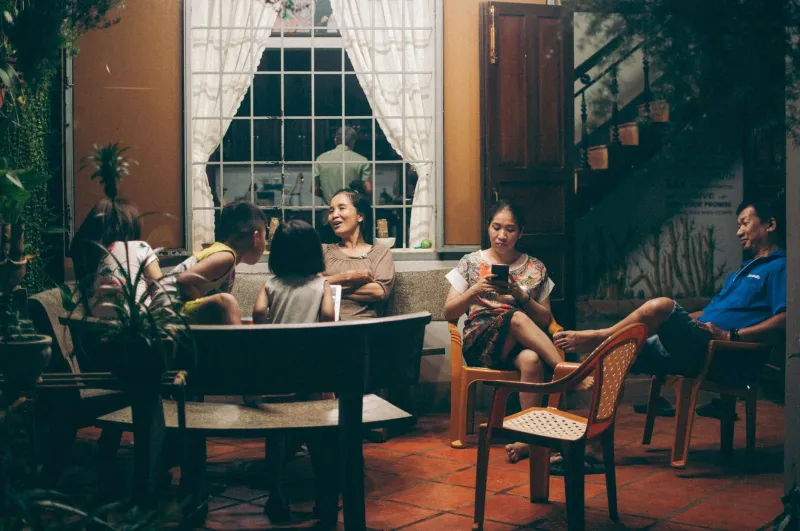
At the same time, proximity and physical presence carry their own meaning. The act of simply being near someone — sitting in the same room, working alongside them in silence — can be a profound expression of care and connection. A mother who sits near her adult child while they work, not talking, not interfering, just present — that's not intrusion. That's love expressed in a register that doesn't require words.
When Two Grammars Collide
The collision between Vietnamese non-verbal norms and American ones creates real, specific challenges — particularly in professional settings.
Vietnamese-American professionals sometimes report being misread in workplace environments. A tendency toward measured eye contact gets interpreted as evasiveness. A preference for listening before speaking gets read as disengagement. A disinclination to self-promote verbally — because competence, in Vietnamese cultural logic, should be visible without announcement — can make it harder to advance in environments that reward louder self-advocacy.
These aren't deficits. They're a different vocabulary. But when the dominant environment only recognizes one vocabulary, the translation burden falls entirely on the person who speaks both.
Passing It Down, Holding It Close
What's remarkable is how persistently these non-verbal codes survive across generations, even when spoken Vietnamese fades and American cultural fluency deepens.
Second and third-generation Vietnamese-Americans who can barely hold a conversation in Vietnamese still know, instinctively, how to move through a family gathering — who gets greeted first, how to position themselves at the table, what a certain kind of quiet from a grandparent means. The body remembers what the tongue has partly forgotten.
That persistence is meaningful. It suggests that this layer of cultural identity is carried not just in language or explicit tradition but in something more physical, more primal — in the way we hold ourselves, the way we enter a room, the way we communicate care without ever having to find the words.
The language beneath the language. It was always there. It always will be.