The Sacred in the Everyday: How Vietnamese-Americans Carry Spirituality Outside the Temple Walls
Every morning before she leaves for work, Sandra Phạm makes two cups of coffee.
One is for her. One is for her grandmother.
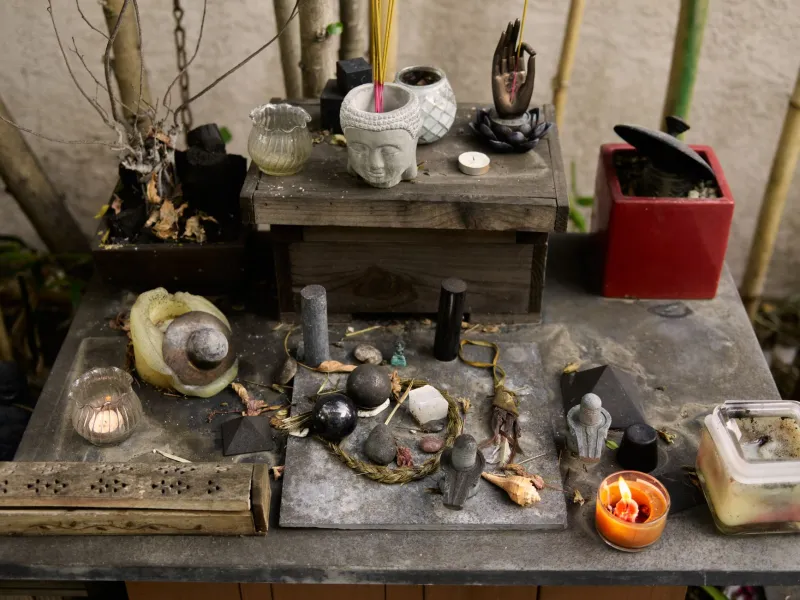
She sets the second cup on the small wooden shelf in her kitchen — not a formal altar, just a shelf with a framed photo, a stick of incense, and a few dried flowers — and she talks. Not out loud, exactly. More like thinking in her grandmother's direction. She tells her about the day ahead. She asks for patience. Sometimes she just says con nhớ bà — I miss you — and leaves it at that.
Sandra is 31, works in healthcare administration in Sacramento, and would not describe herself as particularly religious. But this ritual? Non-negotiable.
"I don't know if she hears me," Sandra says. "But something about doing it makes me feel like I'm not alone. Like I'm still part of something that started before me."
Spirituality That Travels
Vietnamese spiritual tradition is not a simple thing to categorize. It draws from Buddhism, Taoism, Confucian ethics, and a deep-rooted animism that treats the natural world as alive with presence. It includes ancestor veneration so embedded in daily life that it barely registers as religious practice — it's just how you treat your dead.
When Vietnamese families came to the United States, they brought that complexity with them. Some found temples and Buddhist centers that offered familiar ritual and community. But the informal, personal layer of Vietnamese spirituality — the household practices, the food offerings, the conversations with the dead — those traveled too, tucked into luggage that had no room for much else.
What's remarkable is how those practices have adapted, stretched, and in some cases deepened in the American context.
"Displacement can actually intensify spiritual practice," says Dr. Minh-Tâm Cao, who studies religion and diaspora at a university in Southern California. "When you lose access to the physical places that anchor your spiritual life — the family temple, the ancestral village, the graves of your elders — you internalize those practices. They become more portable, more personal, and sometimes more meaningful."
The Altar That Isn't
Formal ancestral altars — the kind with incense holders, fruit offerings, and framed photographs arranged in a specific order — exist in many Vietnamese-American homes. But they share space with a quieter phenomenon: the informal sacred spot.
A corner of a kitchen counter. A windowsill with a single candle and a photograph. A car dashboard with a small Buddha figure and a dried flower tucked into the visor. These aren't altars in the traditional sense. They're something more improvised — spiritual placeholders created by people navigating lives that don't always leave room for formal ceremony.
Trung Lê, a 45-year-old contractor in Houston, keeps what he calls his "little shrine" on the shelf above his workbench in the garage. There's a photo of his father, a small jade figurine his mother brought from Vietnam, and a bottle cap from his dad's favorite beer.
"My dad was not a religious man," Trung says. "But he believed in respecting your ancestors. So I try to do that in a way he would recognize. The beer cap is kind of a joke between us. He would have laughed."
The humor matters. Vietnamese spiritual practice, at its most personal, has always made room for the specific texture of individual relationships — including their lightness.
Commute Conversations and Kitchen Prayers
If you ask Vietnamese-Americans where they feel most spiritually connected, the answers are often surprisingly mundane.
In the car. During cooking. In the garden. At the grocery store, standing in front of a bin of bitter melon and feeling, suddenly and completely, the presence of a grandmother who used to make canh khổ qua every Sunday.
These moments aren't manufactured. They arrive. And many Vietnamese-Americans have learned to receive them — to treat the ordinary as a potential site of connection rather than interruption.
Lena Võ, a teacher in the Pacific Northwest, describes her morning commute as her most reliable spiritual practice. "I drive about forty minutes each way. I use that time to just... talk. To my mom, to my grandparents, to whoever I feel like I need that day. I catch them up on what's happening. I ask for help with hard things. It probably looks like I'm on a hands-free call."
Lena laughs, then gets serious. "But it's the most honest prayer I know how to do. It doesn't require anything except showing up and being real."
Nature as Sacred Ground
For Vietnamese-Americans who grew up with a spirituality rooted in specific landscapes — the Mekong Delta, the Central Highlands, the coastlines of central Vietnam — American geography can feel spiritually neutral. Or worse, spiritually empty.
Some have found ways around that.
Phong Trần, 58, came to the United States as a refugee in the late 1970s and settled eventually in the Pacific Northwest. He describes a gradual process of learning to find the sacred in a landscape that wasn't his.
"In Vietnam, every mountain, every river has spirits. You know where you are in relation to the spirit world because the land tells you. Here, I had to learn to listen differently."
Phong now tends a large garden that includes plants from both Vietnam and the Pacific Northwest — rau muống alongside Pacific ferns, lemongrass beside native grasses. He burns incense at the garden's edge on important dates. He has, over forty years, made the land his.
"It took time," he says simply. "But the spirits travel with you. You just have to make them a new home."
The Practice of Remembering
At its core, what all of these informal spiritual practices share is an insistence on memory as sacred act. The coffee cup for a grandmother. The beer cap on the workbench. The commute conversation. The garden built between two worlds.
These aren't performances of Vietnamese identity. They're not cultural preservation projects. They're just people staying in relationship with what they love and who they've lost — using whatever materials are available.
That, perhaps, is the oldest spiritual technology there is.
Sandra Phạm finishes her morning coffee and rinses both cups. She'll be back tomorrow. So will her grandmother.
Con nhớ bà. I miss you.
The words don't need a temple. They just need to be said.