Grief Without a Word for It: How Vietnamese-American Families Mourn in the Spaces Between
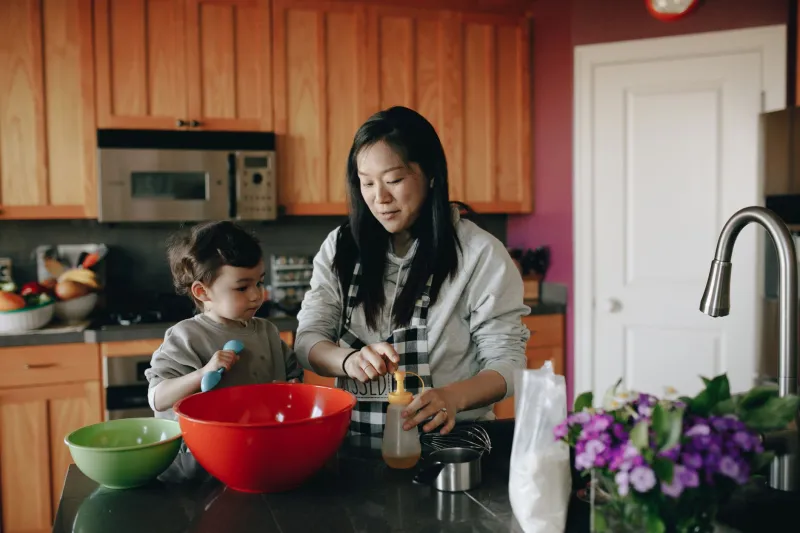
The first anniversary of her father's death, Thủy Bùi made his favorite dish. Not because anyone suggested it. Not because there was a tradition that required it. She just found herself in the kitchen at six in the morning, pulling out the ingredients for bún bò Huế, her hands doing something her mind hadn't quite decided yet.
"I didn't cry that day," she says. "I cooked. And I think that was the same thing."
Thủy is 44 and lives in a suburb of Houston. Her father came to the United States from Vietnam in 1982. He died in 2021, during the pandemic, in a hospital where no family members were allowed inside. She never said goodbye in the way she imagined she would. And the grief of that — the grief of the leaving, and the grief of the life he'd already lost when he left Vietnam — lives somewhere in her that doesn't have an easy address.
For many Vietnamese-Americans, this is simply how loss works. It is not named. It is not scheduled into a grief support group on Tuesday evenings. It moves through the body through ritual, through labor, through food, through a particular kind of silence that is not emptiness but something much fuller.
What Gets Left Unsaid
Western therapeutic traditions — the kind most commonly available in American healthcare settings — tend to operate on the premise that healing requires articulation. Name the loss. Speak the pain. Move through defined stages. This framework has real value, and it has helped a great many people.
But it was not designed with Vietnamese grief in mind.
Vietnamese cultural frameworks around loss are shaped by Confucian ideals of restraint, Buddhist understandings of impermanence, and a collective history of displacement so vast and so recent that processing it individually, in fifty-minute increments, can feel almost absurd.
"My mother lost her home, her country, her language, her siblings who didn't make it out, her entire social world — all before she was 35," says Dũng Lê, 41, a teacher in Virginia. "How do you put that in a grief journal? What stage of grief is that?"
The answer, for many Vietnamese-American families, is that you don't name it. You carry it. And you find other ways to tend to it.
The Language of Ritual
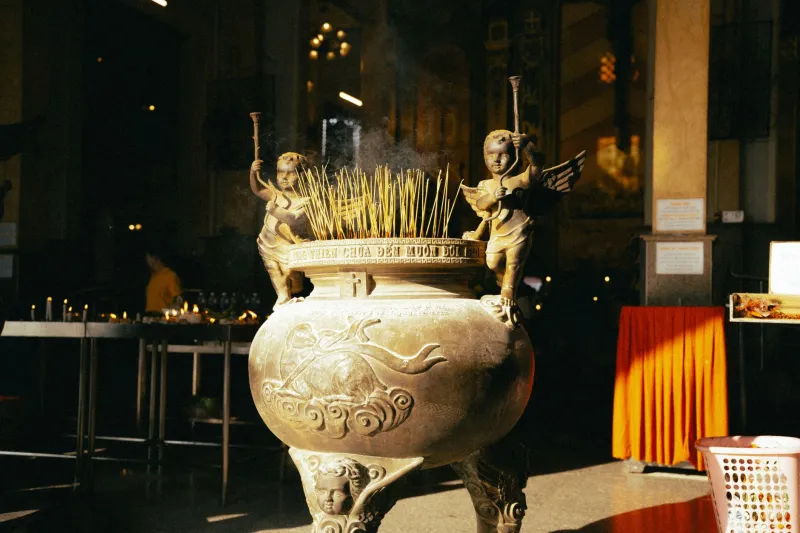
One of the most visible expressions of Vietnamese mourning practice is the ancestral altar — the small shrine found in many Vietnamese-American homes, holding photographs of the dead, incense, offerings of fruit or food or flowers. But the altar is just the visible surface of something much larger.
Grief in Vietnamese culture is often expressed through action rather than declaration. Cooking a deceased parent's recipe. Burning paper offerings during Tháng Cô Hồn, the ghost month. Lighting incense on the anniversary of a death. Keeping a photograph in a specific place in the house and adjusting it, imperceptibly, over the years.
These practices don't require conversation. They don't require a therapist's prompting or a support group's validation. They are self-contained rituals that allow grief to be acknowledged without being exposed.
"My grandmother never talked about the people she lost in Vietnam," says Lan Phạm, 33, a social worker in San Diego. "But every Tết, she made food for people who weren't there anymore. She set a place at the table that no one sat at. That was her grief. And it was complete."
The Particular Weight of Displacement
For Vietnamese-Americans who came as refugees or immigrants, grief is often layered in ways that resist easy categorization. There is the grief of people lost. But there is also the grief of a country left behind — a homeland that may no longer exist in the form it existed in memory, a version of a life that was interrupted and could never be resumed.
Therapists who work with Vietnamese-American communities call this ambiguous loss — a term coined by researcher Pauline Boss to describe grief that lacks the clarity of a single, nameable death. The person is gone, but not entirely. The country still exists, but not the one that was home. The life might have been different, but there's no way to know.
"A lot of my clients are grieving things that have no funeral," says Dr. Mỹ Châu Nguyễn, a therapist in Orange County who works primarily with Vietnamese-American adults. "There's no ceremony for the life you would have lived if history had been different. But that grief is just as real, and it needs somewhere to go."
For many, it goes into work. Into building. Into an almost compulsive forward motion that can look, from the outside, like ambition, but is sometimes also a way of outrunning something that's always just behind you.
When Silence Is the Practice
Not all Vietnamese-American families process loss through ritual or labor. Some process it through silence — a particular, textured silence that family members understand without explanation.
Many Vietnamese-Americans describe growing up in households where certain topics were simply never discussed. The war. The boat. The relatives who didn't survive. Not because the pain wasn't there, but because speaking it directly felt like reopening something that had been carefully, deliberately closed.
"My parents never talked about what happened before they came here," says Việt Hoàng, 38, who grew up in Houston. "But I knew. I always knew. You could feel it in the house. There were things that had weight that nobody named. And I think not naming them was part of how my parents survived."
Dr. Nguyễn is careful to note that this kind of silence isn't always avoidance. Sometimes, she says, it is a form of protection — a way of shielding the next generation from a weight they didn't need to carry, or of keeping a wound from being reopened before it had properly closed.
The challenge comes when that silence gets inherited without context — when the second generation grows up carrying a heaviness they can feel but can't explain.
Finding a New Language for Old Loss
Something is shifting in Vietnamese-American communities, particularly among younger generations who have grown up with greater access to mental health language and less stigma around using it. There is a growing conversation about how to honor the cultural practices that have carried families through unimaginable loss while also making room for more explicit forms of processing.
For some, that looks like therapy — specifically with Vietnamese-speaking or culturally competent therapists who understand the context. For others, it looks like community gatherings where stories are finally told out loud. For others still, it looks like writing, or art, or building organizations that acknowledge the full weight of what this community has survived.
None of this replaces the altar, or the soup, or the silence that holds more than words can.
"I don't think we need to choose between our way and the Western way," says Thủy, the woman who cooked bún bò Huế on the anniversary of her father's death. "I think we need to understand that our way was never nothing. It was always something. We just didn't always have the language to say what."
She pauses.
"Maybe that's okay. Maybe some things are meant to be felt before they're named."