Before the First Word: How Vietnamese-American Families Keep Memory Alive Through Scent
Long before a child can read a history book or scroll through family photos, smell is already doing the work of belonging. For Vietnamese-American families across the country, incense smoke, star anise, and the warm haze of a burning candle are doing something no language lesson ever could — pulling the past into the present.
It happens in a flash. You walk into your grandmother's kitchen in San Jose, and suddenly you're five years old again, sitting cross-legged on a tile floor somewhere far away. The scent doesn't ask for permission. It just arrives.
Why Smell Gets There First
There's actual science behind that gut-punch feeling. Of all the senses, smell is the only one wired directly into the brain's limbic system — the region that governs emotion and long-term memory. Every other sense has to make a pit stop first. Smell takes the express lane.
Dr. Rachel Herz, a neuroscientist and author who studies olfactory memory, has described this as the "Proustian memory" phenomenon — named after the French writer Marcel Proust, who famously described being flooded with childhood recollection by the smell of a madeleine dipped in tea. For Vietnamese-Americans navigating the gap between two cultures, that Proustian shortcut isn't just poetic. It's functional. It's survival.
"I can forget a word in Vietnamese," says Linh Trần, a 34-year-old graphic designer in Houston. "But I have never once forgotten what my mother's kitchen smelled like on the first day of Tết."
The Altar Smoke That Crosses Oceans
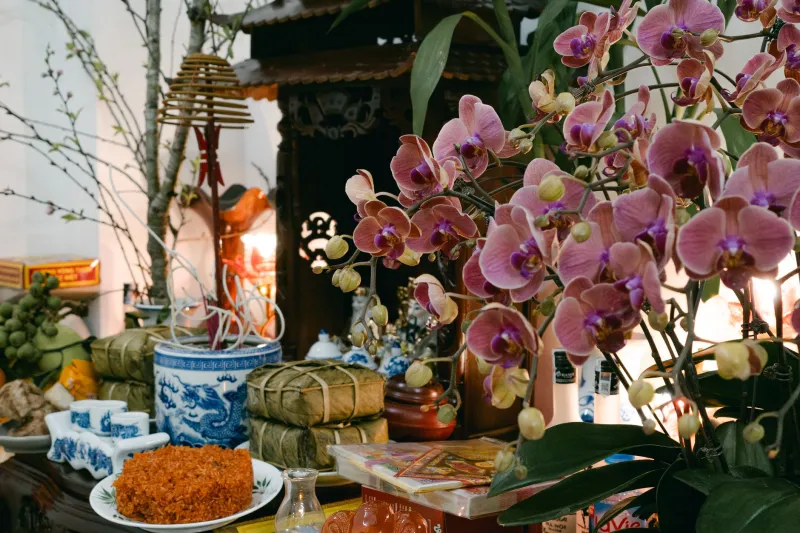
For many Vietnamese-American households, the most emotionally loaded scent isn't food — it's incense. The thin gray spiral rising from a family altar carries a weight that's hard to explain to people who didn't grow up with it.
Thắp nhang — the act of lighting incense to honor ancestors — is one of the most enduring rituals in Vietnamese spiritual life, practiced across Buddhist, Taoist, and even Catholic Vietnamese households in ways that sometimes surprise outsiders. In America, the ritual has adapted. Altars appear in apartment corners, on bedroom dressers, tucked beside kitchen windows. The incense sticks are bought at Asian grocery stores in Little Saigon or ordered online when the local supply runs dry.
But the smoke still means the same thing.
"When I light incense for my parents now, I'm not just honoring them," says Minh Nguyễn, a 58-year-old retiree in Garden Grove, California. "I'm also reminding myself of who I am. That smell is a door. Every time I open it, I go home."
His daughter, Kimberly, who is 27 and grew up mostly in Orange County, admits she didn't always connect with the ritual. "I thought it was kind of old-fashioned when I was a teenager. But after my grandfather passed, I started lighting incense on my own. It felt like I was still talking to him somehow. Now I can't imagine not doing it."
Spices as Storytellers
If incense is the spiritual anchor, the kitchen is the cultural classroom. Vietnamese cooking is a symphony of aromatics — lemongrass, fish sauce, fresh ginger, the licorice warmth of star anise, the sharp brightness of fresh herbs like rau răm and kinh giới. Each one carries a story.
For Thanh Phạm, a home cook and mother of three in Fairfax, Virginia, preparing a pot of phở is never just about feeding people. It's a ritual that begins hours before anyone sits down.
"Charring the onion and ginger — that smell is the beginning of everything," she says. "My kids know dinner is serious when they smell that. They come out of their rooms. They ask questions. That's when the stories happen."
She's noticed that her teenage son, who is otherwise not particularly interested in Vietnamese culture, will stop whatever he's doing when she starts making bò kho. "He says it smells like his childhood. He's only 16. But I think what he means is it smells like safety. Like us."
Nutrition educators and family therapists who work with immigrant communities have long noted this pattern — that food-based sensory rituals create what some call "cultural scaffolding" for children growing up between two worlds. The smell doesn't just comfort. It contextualizes. It says: this is where you come from, and it is something worth carrying.
Candles, Oils, and the Modern Altar
Not every Vietnamese-American family maintains a traditional altar or has access to a well-stocked Asian grocery store. Especially for those in smaller cities or rural areas, the ingredients of scent-based memory sometimes require creative substitution.
A small but growing number of Vietnamese-American makers have noticed this gap — and are filling it. Artisan candle companies run by Vietnamese-American women are crafting scents explicitly designed to evoke cultural memory: lemongrass and coconut, sandalwood and jasmine, green tea with a hint of pandan. Some sell alongside handwritten notes about the memories that inspired the blend.
"I wanted to make something for people like me," says Jade Lê, who runs a small candle business out of Austin, Texas. "People who don't have a grandmother nearby anymore. People who want to feel connected but don't always know how. A candle can't replace the real thing. But it can remind you that the real thing existed — and that it's worth looking for."
Passing the Scent Forward
The question that quietly haunts many first- and second-generation Vietnamese-Americans is this: will my kids feel what I feel when they smell this?
The honest answer is — it depends on whether you give them the chance.
Memory researchers are clear that scent associations are learned, not inherited. A child raised around incense and fish sauce will carry those associations into adulthood. A child who never encounters them won't. Which means the act of cooking together, lighting incense together, even burning a lemongrass candle on a Tuesday evening for no particular reason — all of it is a form of cultural transmission that doesn't require a single word of Vietnamese.
Linh Trần, the graphic designer in Houston, has started a small practice with her four-year-old daughter. Every Sunday morning, she lights a single stick of incense and lets her daughter watch the smoke curl upward. She doesn't explain everything yet. She just lets the smell do its work.
"Someday she'll be somewhere far away," Linh says, "and she'll smell something like this, and she'll feel something she can't quite name. And I hope — I really hope — that feeling will be me. That it'll be her grandparents. That it'll be all of us."
That's the thing about scent. It doesn't need a translation. It just needs a door left open.